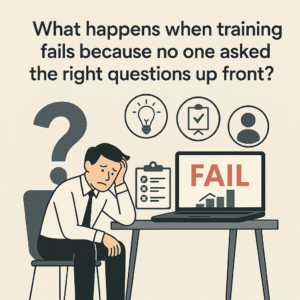
What happens when training fails because no one asked the right questions up front?
It is one of the most frustrating experiences in business. A new training program is rolled out with great energy, the budget is spent, the launch is polished, and leaders are full of expectation. Then, weeks later, the results are disappointing. Performance does not improve, employees shrug their shoulders, and executives start asking awkward questions about value for money.
When this happens, people often look at the quality of the training materials or the skill of the facilitators. In reality, most failures are caused long before the first slide is built or the first learner logs in. They are caused in the Analysis phase, the very beginning of the ADDIE process, where the foundations for success are either laid or ignored.
Why analysis matters
Analysis is often the least glamorous part of instructional design. It involves interviews, surveys, job observations, reviewing performance data, and listening carefully to complaints from the floor. It rarely produces something shiny that can be shown off to leadership. Yet it is the single most important stage in the process, because it defines the problem that needs solving.
Without clear problem definition, training becomes guesswork. People ask for courses that sound useful, but which may not address the real issue. As a result, training becomes a band-aid that soothes symptoms instead of a treatment that tackles causes.
The right questions to ask
Good analysis begins with sharp, practical questions:
- What is the actual performance gap?
- Is this gap caused by lack of skill, poor motivation, broken systems, or unclear processes?
- Who exactly are the learners, and what pressures do they face?
- What will success look like, and how will we measure it?
- What is the cost of doing nothing?
These questions move the conversation away from assumptions and into evidence. They prevent leaders from simply saying, “We need a course on this,” and force everyone to consider whether training is the right answer in the first place.
An everyday example
Imagine a sales team missing its targets. The reflex response might be to commission a new sales skills course. Without analysis, that looks sensible. But analysis might reveal that the real issue is a clumsy CRM system that takes twice as long to use as it should. Or it might reveal that the incentive structure rewards chasing small deals instead of strategic ones.
In both cases, more training would do nothing. What is needed is a system fix or a change in policy. Only analysis uncovers these realities.
Why it gets skipped
If analysis is so vital, why do organisations often skip it? There are several reasons.
First, pressure from above. Leaders want visible activity, and launching a course looks like action. Time spent asking questions looks like delay.
Second, there is the belief that analysis is an unnecessary cost. Why pay for weeks of investigation when a training team could start building content immediately? Ironically, skipping analysis almost always costs more in the long run when the training fails to deliver.
Finally, there is comfort in compliance. Many designers feel safer producing what has been asked for rather than challenging the request. Saying “yes” keeps clients happy in the short term. Asking “why” can make people uncomfortable. But credibility comes from asking “why” and holding the line on good practice.
The benefits of doing it right
When analysis is done well, the benefits are obvious:
- Training is targeted at the real issues, not symptoms.
- Learners find the material relevant and immediately useful.
- Leaders see genuine impact on performance rather than vague claims.
- The L&D team earns respect as a strategic partner rather than an order taker.
Put simply, good analysis saves money, improves results, and builds credibility.
The role of AI
Modern AI tools can make analysis faster and richer. They can crunch large data sets to spot performance trends, cluster survey responses into themes, or quickly transcribe interviews. These are powerful aids, but they are not substitutes for human judgment.
AI will not know which questions to ask in the first place. It will not detect the unspoken concerns in a manager’s tone, or the politics that distort performance data. Human designers still need to interpret the context, weigh the evidence, and make the final call.
Passing the credibility test
The next time a leader says, “We need a course on this, and we need it fast,” pause before you agree. Ask the questions that really matter. Insist on clarifying the problem. Look beyond training as the automatic solution.
Because when you skip analysis, you may deliver on time, but you will almost certainly deliver the wrong thing. And when that happens, your credibility suffers more than the training does.
In the end, analysis is not just the first step in the ADDIE process. It is the credibility test for every learning professional. Do it well, and you will be trusted. Skip it, and you will be forgotten.